
CHANGING STANDARDS OF LIVING: WHEN A HOME'S VALUE IS MEASURED BY MORE THAN SQUARE METRES
A good living space can no longer be judged only by whether it is more beautiful, more spacious, or more convenient. It must also be judged by its role in our daily lives. Does the place we live help us stay healthier and more comfortable, and how long can it help us maintain a good quality of life?
As that question gains weight, the concept of healthspan is entering the real estate conversation. It offers a new lens on the value of living spaces and on the standards we expect from the place we call home.
1. From Lifespan to Healthspan
Lifespan is the total number of years a person lives. Healthspan is the portion of those years we spend in good health: active, mentally sharp, and free from illness or physical decline that significantly limits us.
The gap between these two numbers is becoming one of modern society's major challenges. Medicine has helped people live longer than ever before. But a longer life does not guarantee that every one of those years is lived in good health and with a good quality of life. As a result, the question people ask themselves is shifting from:
"How can I live longer?"
to:
"How can I stay healthy for longer?"
The change in wording is small, but its effects are far-reaching. It is reshaping how we think about healthcare, nutrition, physical activity, the environment, and even how living spaces are designed.
2. When Health Becomes Part of a Property's Value
Some real estate projects around the world are answering this question in notable ways. A prime example is WellEra in Bangkok, a wellness development by Bangkok Dusit Medical Services (BDMS).
Rather than focusing only on familiar financial metrics such as capital appreciation or rental yield, the project takes a different view. It frames healthspan as a kind of return on investment in life itself.
Here, a property's value lies not only in the price it commands but also in how its environment supports residents in preserving their health and quality of life over the years.
WellEra is, of course, a specialised model that tightly integrates healthcare, wellness, hospitality, residential living, and retail. Not every housing project needs to, or should, follow this path. But the thinking behind it is well worth the industry's attention.
Health was once seen as an optional extra. Today it is increasingly becoming the foundation of how a living space is designed.
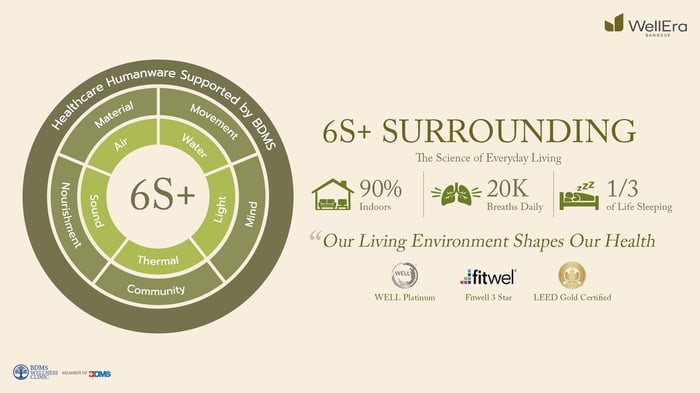
WellEra Bangkok's 6S+ Surrounding model: environmental and lifestyle elements designed around residents' health, combined with healthcare services from BDMS. (Source: WellEra Bangkok)
3. Wellness Is More Than a Spa or a Gym
When people think of wellness in real estate, they often picture a modern gym, a spa, more greenery, or a few health-related amenities.
From an environmental design perspective, however, wellness shows up in subtler, more everyday ways:
- Air quality: The air we breathe every day, with filtration systems quietly controlling fine dust and indoor pollutants.
- Water quality: The purity of the water that supports every part of daily life.
- Light and circadian rhythm: How much natural light reaches the home, and how artificial lighting works in harmony with the body's internal clock.
- Microclimate: A space quiet enough for uninterrupted sleep, with temperature and humidity kept at comfortable levels.
- Community spaces: Green areas and places to exercise, relax, and connect that residents can easily reach every day.
Many of the factors that determine our health do not begin in a hospital. They begin in the place where we wake up each morning and return to each evening.
4. From Amenities to Real Impact on Daily Life
This is why international standards such as WELL, Fitwel, and LEED are attracting growing attention in property development.
The market has traditionally focused on what a project offers. These standards ask a deeper question: what do those features actually do for the people who live there?
- Not just whether there is a ventilation system, but how good the air quality actually is.
- Not just whether there are large windows, but how natural light affects eye health and circadian rhythm.
- Not just whether there is landscaping, but whether residents are genuinely encouraged to move and enjoy the outdoors.
- Not just whether there are amenities, but whether those spaces serve multiple generations, age groups, and stages of life.
This marks an important shift. The focus moves from designing a building's features to shaping the living experience that the building delivers to every resident, every day.
5. A Good Home Must Keep Up as Life Changes
Healthspan also raises a bigger question for the real estate industry: how many years of a person's life is a home designed to support?
An apartment that suits you at 30 may no longer fit when you reach 60. A young couple has different needs from a family with small children, grandparents, or a member who needs accessibility support. Life keeps moving, and our homes need to move with it.
A truly sustainable city, community, or home must do more than stand the test of time. It must be able to adapt to the changing lives of the people within it.
This is where healthspan intersects with ideas gaining traction in property development: future-proof design, inclusive design, and all-ages living.
6. Sustainable Living Starts with People
For many years, sustainability in real estate has mostly been discussed in terms of energy, emissions, materials, and operational efficiency. These remain essential.
Seen from a human perspective, however, the definition of sustainability is broader than ever:
- A sustainable building does more than consume less energy. It also provides a better environment for the people who live in it over decades.
- A sustainable community does more than offer plenty of greenery. It also enables multiple generations to live, move, connect, and adapt together over time.
- A sustainable home is built to last, and it is also designed to help people live healthier, better lives in it for longer.
This may be one of the most meaningful shifts in modern living standards. A property's value is increasingly measured by more than what we own. It is also measured by the quality of life that space helps us preserve over the years.
|
About the Series: The New Standards of Living As life expectancy, technology, family structures, and expectations of quality of life all evolve, the standards for our living environments are being redefined. Through The New Standards of Living series, OSI Holdings invites you to take a closer look at the trends shaping the future of residential real estate. The series covers healthspan, future-proof design, inclusive and all-ages living, wellness living, and environmental standards. It also explores how these ideas are translated into living spaces of lasting value. |
|

 16th Floor, Oriental Square Building, Luu Co Street, Tay Ho Tay Urban Area, Xuan Dinh Ward, Hanoi City
 +(84) 243.207.72.72 -
 info@osi.com.vn -
 www.osi.com.vn
